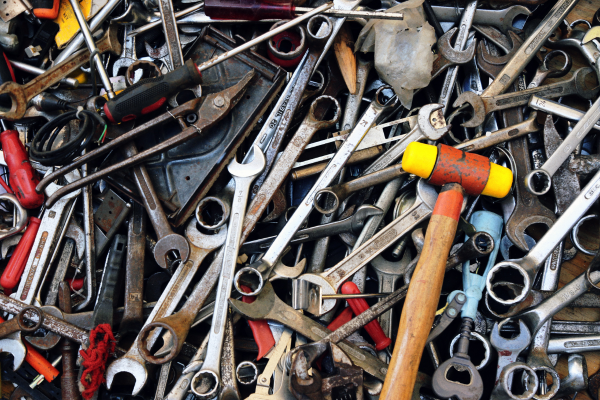
Protecting hand tools from rust often leads to a familiar problem: the more oil you apply, the dirtier the toolbox becomes.
A wrench with a light protective film may resist moisture effectively, but a tool covered in excess oil can quickly collect dust, metal particles, wood fibers, and other workshop debris. Handles can become slippery, drawer liners can become contaminated, and moving mechanisms may accumulate a thick mixture of lubricant and dirt.
Fortunately, rust protection does not require every tool to be visibly oily.
There are several ways to reduce corrosion risk while keeping tools relatively clean and easy to handle. The right approach depends on the tool’s material, its existing finish, how often it is used, the storage environment, and whether the tool is being prepared for everyday use or long-term storage.
The most effective strategy is usually a combination of cleanliness, complete drying, appropriate storage, environmental moisture control, and a suitable protective treatment when necessary.
Why Excess Oil Can Become a Problem
Oil can provide a useful barrier between metal and moisture, but more is not automatically better.
A thin protective film may be enough for a particular application. A heavy coating can create an entirely different maintenance problem.
Excess oil can collect:
- Dust
- Sand
- Metal shavings
- Wood particles
- Fibers
- Dirt from hands
Over time, the mixture can become thick enough to interfere with moving mechanisms.
A greasy wrench may be more difficult to handle.
A heavily coated screwdriver can transfer residue onto everything it touches.
A toolbox drawer can become covered with a sticky film that attracts even more dirt.
The objective of rust prevention should therefore be appropriate protection, not maximum oil coverage.
Start With a Clean Tool
A protective treatment works better when applied to a clean surface.
Before protecting a tool, remove:
- Dirt
- Grease
- Old contaminated lubricant
- Paint residue
- Adhesive
- Metal particles
- Moisture
A surface covered with contaminated grease is not necessarily well protected.
If the grease contains abrasive particles or trapped moisture, simply adding more oil can make the problem worse.
Clean the tool using a method appropriate for its material and finish.
Mild soap and water may be suitable for some tools.
A compatible degreaser may be more appropriate for heavier contamination.
Follow the manufacturer’s instructions when they are available.
Drying Is More Important Than Oiling
One of the most important principles in rust prevention is simple:
Do not trap moisture underneath your protective treatment.
If a tool is washed and immediately coated while still wet, the protective film may remain over moisture that is already sitting against the metal.
That is not an ideal starting point.
After cleaning, dry the tool thoroughly.
Pay attention to:
- Joints
- Threads
- Grooves
- Recesses
- Socket interiors
- Hinges
- Areas around handles
Allow the tool to air-dry completely when appropriate.
A dry tool stored in a suitable environment may need surprisingly little additional protection.
Control the Storage Environment
The easiest way to reduce reliance on oil is to reduce the amount of moisture your tools encounter.
A tool stored in a dry indoor cabinet may require less surface protection than the same tool stored in a humid garage.
Look at:
- Garage humidity
- Condensation
- Damp floors
- Water leaks
- Wet tools
- Toolbox condition
- Air circulation
- Temperature changes
A hygrometer can help identify whether humidity is contributing to recurring corrosion.
If several tools rust despite being clean, changing the storage environment may be more effective than continually applying more oil.
Use the Tool’s Existing Finish
Many tools already have a protective finish.
Depending on the tool, this may include:
- Chrome plating
- Paint
- Powder coating
- Black oxide
- Stainless steel construction
- Other factory-applied treatments
When the original finish remains intact, you may not need a heavy additional coating.
The important thing is to avoid damaging that finish during cleaning.
Aggressive sanding or abrasive cleaning can remove some of the very protection you are trying to preserve.
Treat the factory finish as part of the tool’s corrosion-defense system.
Consider Dry or Low-Residue Corrosion Protection
Some products are designed specifically to provide corrosion protection without leaving a heavy oily surface.
Depending on the application, these may include:
- Dry-film corrosion inhibitors
- Low-residue protective sprays
- Specialized storage coatings
- Corrosion-inhibiting packaging
- Protective waxes
The exact performance and suitability depend on the product.
Do not assume that a product described as “dry” or “non-oily” is universally suitable for every metal, finish, or tool.
Read the label and confirm compatibility.
The advantage of these products is that they can provide a protective barrier while reducing the sticky feel associated with heavy oils.
When Wax Can Be Useful
Wax can be particularly useful for tools going into storage.
A suitable protective wax can create a more persistent barrier than a very light oil film while leaving a less oily surface after it has set.
This can be convenient for:
- Long-term storage
- Rarely used tools
- Exposed steel surfaces
- Specialty tools
However, wax is not automatically appropriate for every application.
It may be inconvenient on moving mechanisms.
It may need to be removed before certain types of use.
Some finishes may not be compatible with a particular product.
Follow the product and tool manufacturer’s instructions.
Use Oil Selectively
There is nothing wrong with using oil when oil is the correct solution.
The key is to use it selectively.
For example, a corrosion-sensitive bare-steel surface stored in a humid environment may benefit from a thin protective oil film.
A simple chrome-plated wrench used several times a week may need much less surface treatment.
A pivot designed to be lubricated may require a small amount of lubricant for mechanical reasons.
These are different situations.
Think about where protection is needed, rather than treating the entire toolbox with the same product.
Separate Lubrication From Corrosion Protection
This distinction is easy to overlook.
Lubrication and corrosion protection can overlap, but they are not identical purposes.
A lubricant is primarily intended to reduce friction or wear in a mechanism.
A corrosion inhibitor is intended to reduce exposure of metal to corrosive conditions.
A product may perform both functions, but you should not assume that every lubricant is an effective long-term corrosion inhibitor.
Likewise, a protective storage coating may not be appropriate for a moving joint.
Knowing which problem you are trying to solve helps prevent overapplication.
Protect Only the Vulnerable Surfaces
Another way to keep tools clean is to focus treatment where it matters.
Suppose a wrench has a well-protected handle and plated body but a small exposed steel area where the finish has worn away.
You may not need to coat the entire tool.
A controlled application to the vulnerable area may provide adequate protection.
This is particularly useful for older tools with localized finish damage.
Targeted maintenance reduces residue while preserving the rest of the tool in a cleaner condition.
Keep Protective Products Away From Handles When Possible
Handles usually do not need the same corrosion protection as exposed metal.
Plastic, rubber, and composite surfaces can also react differently to chemicals.
Avoid spraying the entire tool indiscriminately.
Apply protective products to the intended metal surfaces.
Use a cloth or other controlled method when the product allows it.
This minimizes unwanted residue on grips.
A clean, dry handle is usually easier and safer to hold than one covered in oil.
Clean Tools Before Long-Term Storage
If a tool will be stored for several months, cleanliness becomes particularly important.
Before storage:
Remove contamination.
Dry the tool completely.
Inspect for corrosion.
Repair or address existing rust where appropriate.
Apply suitable protection.
Store in a dry environment.
This can be more effective than simply applying a thick layer of oil.
Long-term protection is a system.
The coating is only one part of it.
Use Enclosed Storage Carefully
A closed container can provide another layer of protection against environmental exposure.
However, the container must be prepared correctly.
Do not seal damp tools.
Do not place wet rags inside.
Do not assume that closing the lid automatically creates a dry environment.
For particularly corrosion-sensitive tools, a suitable container combined with desiccant and appropriate corrosion protection may offer better results.
The exact approach depends on the storage duration and environment.
Silica Gel as an Additional Layer
Silica gel can help reduce moisture in appropriately enclosed storage spaces.
It can be particularly useful for:
- Small tool cases
- Drawers
- Storage bins
- Specialty tool containers
It does not replace proper drying.
It also does not solve a persistently humid garage.
Used correctly, however, it can reduce the amount of moisture surrounding already clean and dry tools.
This can allow you to rely less heavily on oily surface coatings.
Corrosion-Inhibiting Packaging
For tools that need extended protection, specialized corrosion-inhibiting packaging can be another option.
Depending on the product, these materials can create an environment designed to slow corrosion around stored metal.
This can be useful when storing valuable or specialty tools for long periods.
Follow the manufacturer’s recommendations for sealing, compatibility, and storage duration.
There is generally no need to use specialized packaging for ordinary everyday tools if simpler methods are sufficient.
Do Not Confuse “Dry” With “Unprotected”
A tool does not have to be oily to be protected.
Protection can come from several layers:
Factory finish
Clean surface
Dry storage
Humidity control
Appropriate corrosion inhibitor
Desiccant
Suitable enclosure
Oil is only one possible layer.
This is an important shift in thinking.
Instead of asking:
“How much oil should I use?”
ask:
“What conditions will this tool experience, and what level of protection does it actually need?”
The answer will vary from tool to tool.
What About Stainless Steel?
Stainless steel can resist corrosion better than ordinary carbon steel in many situations, but “stainless” does not mean “impossible to corrode.”
Different stainless-steel alloys behave differently.
Contamination, salts, chemicals, moisture, and surface damage can still contribute to corrosion.
Routine cleaning and appropriate storage remain important.
Do not assume that stainless tools never need maintenance.
At the same time, unnecessary oiling of a relatively corrosion-resistant tool can create residue without providing much practical benefit.
Chrome-Plated Tools Usually Need Less Surface Coating
Chrome plating provides a protective surface, so routine maintenance can often focus on cleanliness and preventing damage.
A clean, dry chrome-plated tool stored in a reasonable environment may not need to be heavily oiled.
Pay attention to:
- Scratches
- Chips
- Damaged plating
- Exposed steel
- Corrosion around joints
If the plating is intact, avoid aggressive cleaning methods that could damage it.
Preserving the finish is often more useful than adding excessive oil.
Black-Oxide and Other Finished Tools
Tools with darker finishes may use black oxide or other surface treatments.
These finishes can have different maintenance requirements from chrome plating.
The specific manufacturer’s guidance should take priority.
Some finishes may benefit from light protective treatment, while aggressive cleaning can remove or alter the surface.
When the finish is unknown, start conservatively.
Do not assume that all dark metal surfaces are identical.
What About Cutting Tools?
Cutting tools require extra caution because a protective coating should not interfere with the working edge.
For long-term storage, an appropriate corrosion inhibitor may be useful on compatible exposed metal.
Before using the tool again, follow the product instructions regarding removal or cleaning.
Do not leave a heavy oily film on a cutting edge if the manufacturer does not recommend it.
The working surface needs to remain appropriate for its intended application.
What About Screwdrivers?
Screwdrivers generally do not need to be coated heavily.
The shaft can be kept clean and dry.
If corrosion protection is necessary, use an appropriate thin treatment.
Avoid saturating the handle.
For screwdriver tips, avoid products that make the working end unnecessarily slippery immediately before use.
The objective is protection during storage without interfering with normal operation later.
What About Wrenches and Pliers?
Wrenches and pliers often benefit from basic environmental control more than excessive surface treatment.
Keep them clean.
Dry them after wet work.
Inspect their finish.
Protect vulnerable exposed metal when necessary.
For pliers, distinguish surface corrosion protection from lubrication of the pivot.
For wrenches, pay attention to adjustment mechanisms and threads where applicable.
A light, targeted approach is usually easier to maintain than completely coating the tool.
Signs That You Are Using Too Much Oil
If your tools consistently show:
- Sticky surfaces
- Thick oily residue
- Dust accumulation
- Dirty drawer bottoms
- Greasy handles
- Contaminated organizers
- Dirt packed into joints
you may be applying more product than necessary.
This does not necessarily mean the oil itself is wrong.
The quantity or frequency may simply be too high for the storage conditions.
Reduce the amount and reassess whether the tool remains adequately protected.
A Better Maintenance Cycle
Instead of oiling every tool on a fixed schedule, use a condition-based approach.
Inspect
Look for moisture, corrosion, and contamination.
Clean
Remove dirt and old residue.
Dry
Eliminate moisture completely.
Evaluate
Determine how much protection the tool actually needs.
Protect
Use a suitable product only where appropriate.
Store
Keep the tool in a dry, organized environment.
Reinspect
Check whether the protection is still adequate.
This approach reduces unnecessary product use while maintaining a high level of protection.
Common Mistakes
Coating wet tools
This can trap moisture.
Oiling every surface
Different materials and components have different needs.
Using heavy oil in dusty environments
This creates a contamination trap.
Ignoring environmental humidity
Surface treatments cannot completely compensate for a poor storage environment.
Applying storage products to working surfaces without checking compatibility
The treatment may interfere with normal use.
Assuming factory finishes need to be replaced with homemade protection
An intact factory coating may already provide substantial protection.
Using the same product for lubrication and storage protection without checking its purpose
The requirements can differ significantly.
A Simple Low-Oil Rust-Prevention Routine
For everyday household tools, a practical routine can be:
After use: wipe away visible dirt and moisture.
After wet work: dry the tool completely.
During inspection: look for corrosion and finish damage.
When necessary: apply a thin, appropriate corrosion inhibitor to vulnerable metal.
For long-term storage: consider a suitable wax, dry-film product, or corrosion-inhibiting storage method.
Inside enclosed cases: use appropriate desiccant when useful.
This provides several layers of protection without requiring every tool to remain oily.
Final Thoughts
Protecting tools from rust does not mean covering them in oil.
The strongest approach is usually a combination of clean surfaces, complete drying, suitable storage, environmental moisture control, and targeted corrosion protection.
Oil remains useful when it is the right product for the tool and application, but excessive oil can attract dirt and turn routine maintenance into a larger cleaning problem.
For many tools, preserving the original factory finish and controlling humidity may do more than repeatedly adding heavy coatings.
When additional protection is needed, consider whether a thin corrosion inhibitor, suitable wax, dry-film product, desiccant, or specialized storage material is better suited to the job.
Think about the tool’s actual environment and storage period rather than applying the same treatment to everything.
The goal is not to make your toolbox oily.
The goal is to keep your tools clean, dry, protected, and ready to use.
A well-designed maintenance routine can achieve all four without leaving greasy residue on every surface.
Related Guides
- Why Tools Rust in a Garage Even When They Stay Indoors
- How to Prevent Rust on Hand Tools in a Humid Garage
- How to Store Metal Tools During Long Periods of Humidity
- Is Oil or Wax Better for Protecting Metal Tools From Rust?
- How to Use Silica Gel to Reduce Moisture Around Stored Tools
FAQ
Do I have to oil all my tools to prevent rust?
No. Rust prevention can involve clean and dry storage, humidity control, existing protective finishes, corrosion inhibitors, suitable waxes, desiccants, or other appropriate methods. Oil is only one option.
Why does too much oil make tools dirty?
Oily surfaces can collect dust, metal particles, wood debris, and other contaminants. Over time, the mixture can become sticky and difficult to clean.
Can wax protect tools without making them oily?
A suitable protective wax can provide a relatively persistent barrier while leaving a less oily surface after it sets. Its suitability depends on the tool, finish, and storage application.
Should I use corrosion inhibitor on chrome-plated tools?
Not automatically. Chrome plating already provides a protective finish. Focus on keeping the tool clean, dry, and free from damage, and follow the manufacturer’s recommendations for any additional product.
Can silica gel replace rust-prevention oil?
Not completely. Silica gel reduces moisture in suitable enclosed spaces, while a corrosion inhibitor provides a protective surface layer. They can be complementary rather than interchangeable.
Should I protect tools before storing them for several months?
Cleaning, complete drying, inspection, and appropriate corrosion protection can be useful before long-term storage, especially in humid environments. The right level of protection depends on the tool and storage conditions.
Can I use a dry-film corrosion inhibitor instead of oil?
A product specifically designed as a dry-film or low-residue corrosion inhibitor may be suitable for certain applications. Check compatibility with the tool and follow the manufacturer’s instructions.
How can I tell if I am using too much oil?
Sticky surfaces, excessive dust accumulation, greasy handles, dirty drawer bottoms, and contaminated joints can indicate that too much product is being applied.
What is the best way to protect tools in a humid garage without oil?
Start by controlling humidity and keeping tools completely dry. Maintain the toolbox, use appropriate storage, and consider targeted corrosion protection or supplemental desiccants for particularly vulnerable tools.