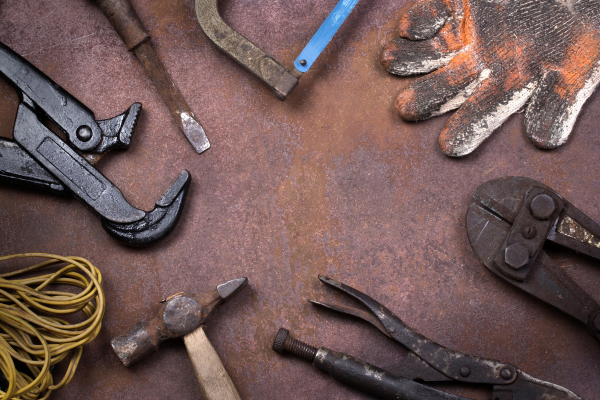
Rust is one of the most common problems affecting steel tools. A small amount of surface oxidation may initially seem cosmetic, but corrosion that remains untreated can gradually penetrate the metal, create pits, damage working surfaces, and eventually compromise the strength of the tool.
When rust becomes deep, simply brushing away the orange discoloration is not enough. The tool must be cleaned carefully so the actual condition of the underlying steel can be evaluated. A heavily rusted tool may still be suitable for restoration, but in other cases corrosion may have removed enough material to make continued use questionable.
The objective of rust removal should therefore be more than improving appearance. A good restoration process removes corrosion while preserving as much sound metal as possible and allows the user to determine whether the tool remains suitable for its intended purpose.
Different tools have different safety requirements. A lightly loaded scraper is not evaluated in the same way as a wrench, socket, clamp, striking tool, or other item subjected to significant mechanical force. When structural integrity is uncertain, replacement or professional assessment may be more appropriate than restoration.
Understand How Rust Develops
Rust forms when iron or steel is exposed to moisture and oxygen.
The process can be accelerated by humidity, condensation, water exposure, salts, dirt, and certain chemicals.
Tools stored in garages, sheds, basements, vehicles, or outdoor work areas can be particularly vulnerable because temperatures and humidity levels may change significantly.
Moisture does not need to appear as visible water.
A cold steel tool moved into warmer humid air can develop condensation on its surface. If this happens repeatedly, corrosion can begin even when the tool has never been directly exposed to rain.
Once rust starts, rough areas can retain additional moisture and contaminants, allowing corrosion to progress.
Surface Rust and Deep Rust Are Different Problems
Before choosing a restoration method, determine how severe the corrosion appears to be.
Surface rust generally forms as a relatively thin layer on the exterior of the steel. After removal, the underlying surface may remain mostly smooth.
Deep rust is different.
As corrosion progresses, it can remove actual metal and leave depressions or pits behind.
These pits may appear as small dark holes, irregular cavities, or rough sections after the loose corrosion has been removed.
The deeper the corrosion, the more important structural assessment becomes.
Removing rust does not replace the steel that has already been lost.
Clean the Tool Before Evaluating the Rust
Grease, oil, dirt, and old residue can make corrosion difficult to evaluate.
Begin by cleaning the tool using a method appropriate for its materials.
Remove loose dirt and contamination.
If the tool has handles made from wood, rubber, or plastic, protect them from cleaning products that could cause damage.
After cleaning, dry the tool and inspect the rusted areas under good lighting.
At this stage, avoid making a final decision about the tool’s condition. Heavy rust can make damage look worse or less severe than it actually is.
The true condition becomes clearer after loose corrosion has been removed.
Inspect the Entire Tool
Do not focus only on the most visible rusty section.
Corrosion may also be developing in:
- Joints
- Threads
- Socket interiors
- Hinges
- Handle connections
- Recessed areas
- Ratchet heads
- Wrench openings
- Adjustment mechanisms
- Contact surfaces
Use adequate lighting and examine difficult areas carefully.
A tool may have relatively light rust on its exterior while more serious corrosion exists in a hidden high-stress area.
Decide Whether Restoration Is Appropriate
Not every rusty tool should automatically be restored.
Before investing significant effort, consider the type of tool and its condition.
Restoration may be reasonable when corrosion appears limited and the tool remains structurally sound.
Replacement may be safer when there are visible cracks, severe deformation, extreme pitting, significant material loss, or corrosion in a critical load-bearing area.
The value of the tool is also relevant.
Restoring an old specialty tool that is difficult to replace may make sense, while heavily restoring an inexpensive socket with questionable strength may not.
Function and safety should be more important than the desire to save every tool.
Begin With Mechanical Removal of Loose Rust
Loose corrosion should generally be removed before more detailed evaluation.
A suitable wire brush, abrasive pad, or other mechanical method can remove flaky rust from robust steel surfaces.
Start gently.
The goal is to remove corrosion products rather than grind away healthy steel.
Use controlled pressure and inspect the surface frequently.
For precision tools or surfaces with critical dimensions, aggressive abrasion may not be appropriate.
Choose Abrasives Carefully
Coarse abrasives remove material quickly, but that is not always desirable.
If a tool has deep rust, the temptation may be to grind the surface until every pit disappears.
This can remove a substantial amount of sound steel.
The objective is not necessarily to create a perfectly smooth surface.
If eliminating eve